


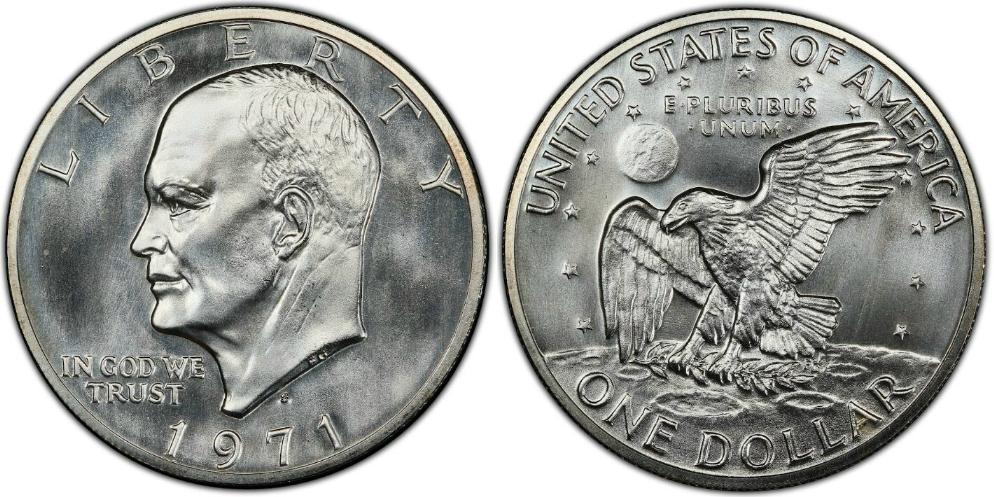
  This 40% silver 1971-S Ike dollar was struck from the first prototype dies whose most obvious difference is the weak globe on the reverse. The following is from GreatCollections.com 10/18/2026 auction which offered the discovery coin: "Among the rarest silver dollars struck since 1794, the 1971-S Prototype 40% silver Eisenhower dollar was first identified by collector Lee C. Lydston at the Long Beach Coin Expo on February 15th, 2008. Lydston found the present coin mixed into an otherwise nondescript tube of 40% Eisenhower dollars and purchased it after observing that its fabric differed from other uncirculated 40% silver 1971-S dollars. In addition to surfaces which resembled those of a satin proof, Eisenhower experts determined that details on the coin’s reverse – most notably several craters visible on the moon – were unknown on other regular-issue Ikes. Further research revealed that these features were present on Frank Gasparro's original plaster model for the Eisenhower reverse but were removed by the sculptor prior to the adoption of the final Eisenhower dollar design. In the 18 years since its discovery, two other 1971-S Eisenhowers were discovered bearing the Gasparro's original reverse design, and, as a group, the pieces have been presented as "Prototype Strikes." In the last year, the Eisenhower prototypes were assigned Judd number 2147 and have been added as a major variety by the Red Book. Since their discovery, collectors and experts have suggested a variety of theories to explain the existence of these pieces. The most likely reason can be deduced from a pair of press releases issued by the Philadelphia Mint in January of 1971. The first of these, dated January 19th, 1971, announced that: For the first time in its history, the U.S. Mint is permitting the news media to witness the trial strike of a coin as well as the designing and engraving process. On Monday, January 25, 1971, at 11:00 AM, the first trial strikes of the new dollar coin bearing the likeness of former President Dwight D. Eisenhower will be made at the U.S. Mint in Philadelphia, Pennsylvania. The Eisenhower dollar coin, provided for in the 1970 Coinage Law, is the first dollar coin to be produced since 1935. Because of the great public interest in its issuance, the Director of the Mint, Mary T. Brooks, is inviting the news media to see the preliminary production process. A second document distributed to members of the press attending the trial strike event held on January 25, 1971, stated that that coins produced that day were struck on "40% silver blanks" from "prototype dies" produced prior to “sharpening up of each design detail." Excerpts form that document make it clear that the Philadelphia Mint's striking event was concerned with the dies for San Francisco’s 40% silver dollars, and specifies that the dies being used were from an early, unadopted version of Gasparro's design: Several trial working dies of the obverse and reverse of the Eisenhower dollar coin have been prepared by the Mint's engraver. Because dies of identical design may vary in height of relief and shape of the basin (background), a succession of preliminary strikes are necessary to determine the best combination of dies to use to produce the best coin within the limitations of coining press equipment and die tools. For example, too high relief, or improper shape of the basin would result in improper flow of the metal in the blanks and consequent damage to the dies or the coining press itself. (Too much pressure would be required to bring up all of the design elements.) The 40% silver blanks used today for the trial strikes of the Eisenhower dollar coin were especially prepared by the coiner, and the strikes you are witnessing involve the final step in determining the best combination of dies, collars and shape of the upset blank. However, the prototype dies in use are not the final product. The engraver still has several weeks’ work to do with the preparation of official master dies and hubs. Such work involves the painstaking removal of every tiny defect and the sharpening up of each design detail. After final approval of the master dies and hubs, this year's master hubs will be made and will be used in the production of all working dies for 1971." So far, 3 pieces are confirmed. Image courtesy of PCGS. |